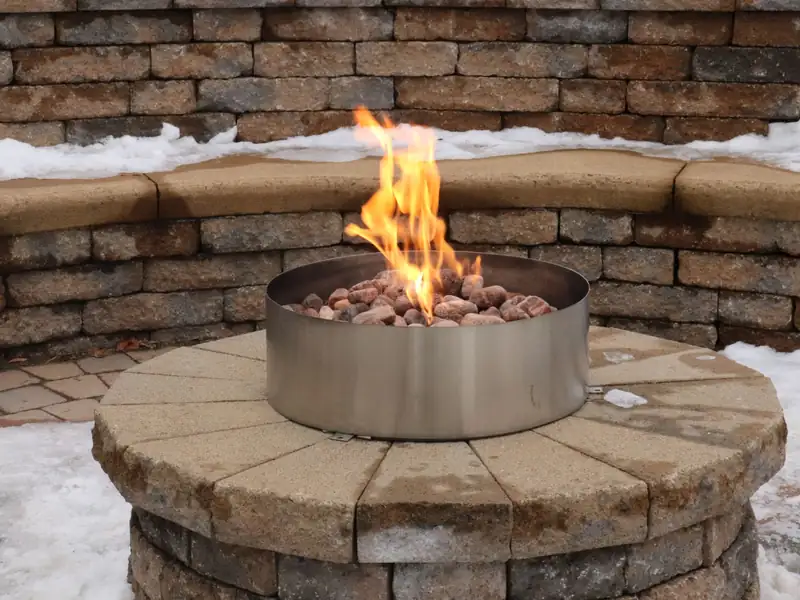
Laying out the fire and the seating
The usual layout is a round fire ring in the middle of a paved circle, with a sitting wall wrapping part of the way around it and an open side facing the house or the view. The open side matters: it's where people walk in, where you carry firewood, and where the smoke has somewhere to go on a still night.
Size comes from how many people you want around it. Leave enough room between the wall and the fire that knees aren't roasting and someone can walk behind a chair. If the circle is part of a bigger patio, we pour the paved area and the fire pit pad in the same job so the transitions are flush and nothing settles at a different rate.
Wood-burning or gas
| Wood-burning | Gas | |
|---|---|---|
| The fire | Crackle, smell and real heat | Flame at the turn of a key, no smoke |
| What it takes | A steel liner and a drain in the bottom of the ring | A gas line run to the pit and a burner kit, installed by a licensed plumber or gas fitter |
| Upkeep | Scooping ash, keeping wood dry | Very little |
| Local rules | Recreational fires are regulated by the city and the state; clean, dry wood only | Usually treated differently from open wood fires; check your HOA |
Either way, the ring itself gets a heat-rated liner or firebrick on the inside so the fire never sits directly against concrete or wall block, which can crack or spall when it's heated and cooled over and over.
Building a wall people actually sit on
A sitting wall is a short retaining-style wall topped with a flat cap. Comfortable seat height is roughly the height of a dining chair, and the cap needs enough depth to sit on without perching. The wall gets its own footing below the frost line or a thickened pad under it, so it doesn't lean or crack as the ground freezes.
Walls can match the patio in stamped and colored concrete, or use a contrasting block with a smooth cap. Where the yard slopes, the wall can do double duty as a retaining wall on the uphill side and hold back the grade while giving you seating.
Where a fire pit can go
Placement is the first thing we look at on site: distance from the house, the deck, fences, overhanging trees and the property line, plus what your subdivision's covenants say. Noblesville and the neighboring cities each regulate backyard fires, and Indiana's open-burning rule separates a recreational fire from burning trash or yard waste.
Check the burn rules first
We pulled the actual local rules together, with links to the city and state sources: backyard fire pit rules around Noblesville.
How the build goes
Pick the spot
We mark the circle, check setbacks and slope, and decide on wood or gas.
Dig and set footings
Footings for the wall and a compacted base for the paved circle go in first.
Ring and wall
The fire ring and liner go in, the wall is built up to seat height and capped.
Pour the circle
The paved circle or patio is poured, stamped and colored to match, then sealed.
We build fire pits and sitting walls in backyards across Noblesville, Fishers and McCordsville.