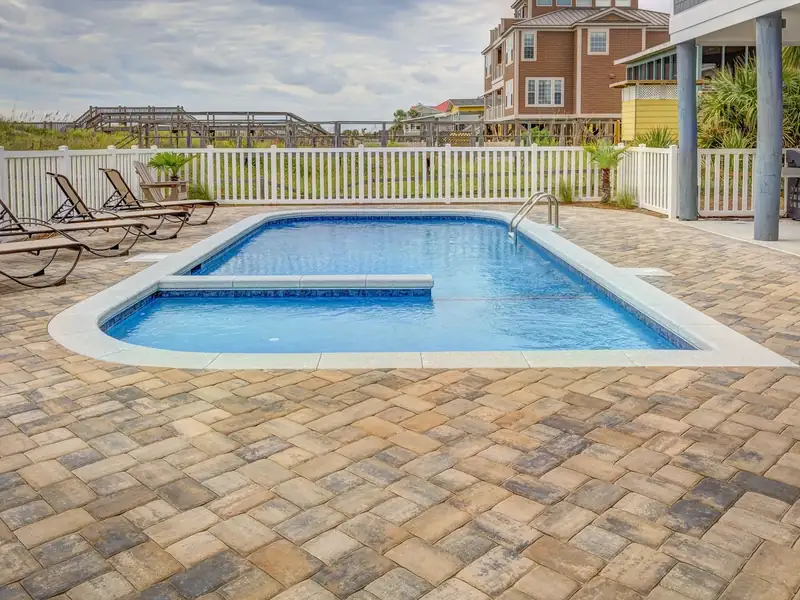
The walk-around test
Walk the whole deck barefoot and look closely. Each yes in the first list points toward replacement; if everything you find is in the second list, resurfacing is on the table.
Signs it needs replacing
- A slab edge sits higher or lower than the one next to it, enough to catch a toe.
- The deck has pulled away from the coping, or tilts toward the pool.
- Cracks run all the way through a slab and are wider each spring.
- Water stands on the deck after rain instead of draining off.
- Pieces are loose or hollow-sounding when you tap them.
Signs it can be resurfaced
- Faded, blotchy or stained color.
- Worn or rough texture, or an old coating that's peeling.
- Hairline cracks that aren't growing.
- A glossy old sealer that has gotten slick.
What Indiana's pool code asks of a deck
Indiana's residential pool rules (675 IAC 14-4.4, Section R326) set a few standards that help settle the question:
- Deck surfaces have to be slip-resisting and easy to clean.
- Decks must drain without leaving standing water, with a slope of at least 1/8 inch per foot on textured concrete and no more than 1 inch per foot.
- The joint between coping and deck has to be watertight, and expansion joints are required where the deck meets other concrete.
- Adjoining slabs can't differ by more than a quarter inch in height or have gaps over 3/16 inch.
An overlay can fix slip resistance, looks and the coping joint. It can't fix slope that runs the wrong way or slabs that have shifted out of line; those mean the deck needs to come out. Source: 675 IAC 14-4.4-38.
Resurfacing and replacement, compared
| Resurface | Replace | |
|---|---|---|
| What happens | Clean, repair, overlay, color and seal the existing deck | Break out the deck, rebuild the base, pour and finish a new one |
| Cost | Lower | Higher |
| Time | Shorter; no tear-out or cure wait for a new slab | Longer; demolition, base work and curing |
| Fixes | Color, texture, grip, stains, minor cracks | Settling, heaving, bad slope, wide cracks, and everything above |
| Won't fix | Movement in the slab underneath | Nothing, if the base is rebuilt right |
Sometimes the answer is both: replace the sections that have moved, then resurface the whole deck so old and new match. See pool deck enhancement for resurfacing and pool deck replacement for a full tear-out. We work on pool decks all over Carmel, Fishers and Noblesville.